
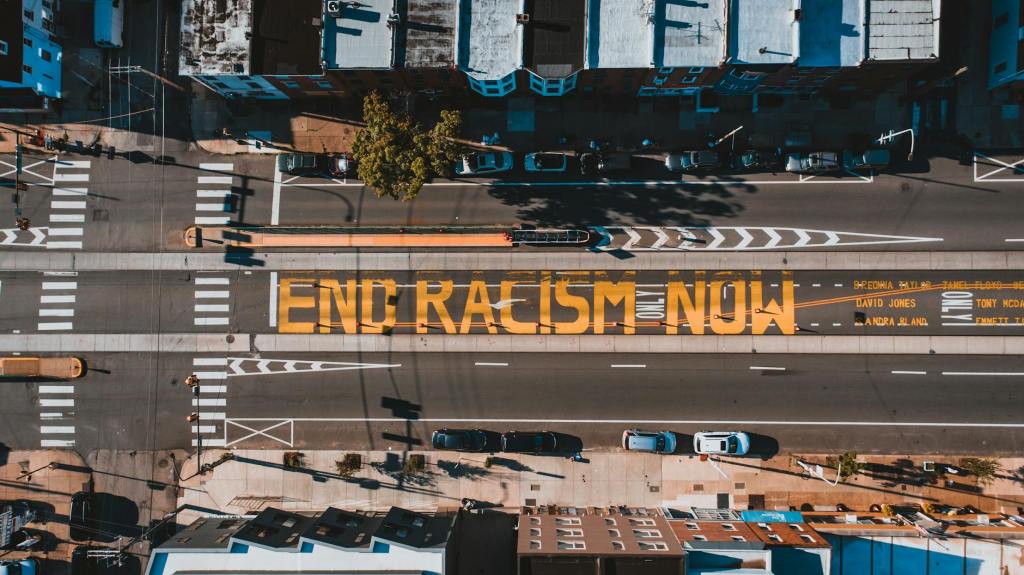
In our latest episode of the podcast, we were delighted to be welcomed by award-winning journalist and author, Tomiwa Owolade, to discuss the central arguments of his book This Is Not America, which emphasises the need for a British-specific conversation about race rather than adopting an American lens. Tom explains key differences between race relations in the UK and the US, including historical and demographic distinctions, and highlights the importance of addressing race alongside factors such as class, geography, and culture.
Because the audio quality was a little spotty in parts, we’ve transcribed the episode in full below. Please note the transcription below has been slightly edited for clarity. If you would like to listen to the episode, head to our podcast page.
Our Interview with Tomiwa Owolade
Oliver Ward: My guest today is Tomiwa Owolade, who is a journalist and award-winning author, who has written widely about social, cultural, and literary issues for The Observer, The Telegraph, The New Statesman, UnHerd, and the Evening Standard, and is currently a columnist at The Times. Tomiwa also won the Giles St Aubyn Award from the Royal Society of Literature for the book that we’re going to discuss today, This is Not America: Why We Need a British Conversation About Race, which came out last year. Tomiwa, thank you so much for being here, and congratulations on the book.
Tomiwa Owolade: Thank you very much.
Oliver Ward: It’s great to have you, and to talk about race, which is such a fundamental issue for both the UK and the US, and anyone thinking of moving needs to understand the important differences between our two countries. So, let’s start with the main arguments of the book. Your book makes two main arguments: that we in Britain are not like America in terms of race and ethnicity; and secondly, that when it comes to race, we need to be more specific in our focus and look at groups and individuals not just through the lens of race and ethnicity, but also class, geography, culture, religion, and language, and so on. So, let’s talk about that first point a bit—how is Britain not America?
Tomiwa Owolade: Britain is not America for various reasons, but when it comes to race, Britain is very different to America for a couple of very significant reasons. One of them is that the Black American population is much larger than the Black British population. Black Americans constitute about 12% of the overall American population, whereas the Black British population only constitutes about 4% of the overall British population. And even if we sort of go back in time—ever since America became a republic in the late 18th century—the share of the Black population has always been between what it is now and about 20% of the American population. Whereas, if we compare that to the UK, 4% is the highest in terms of the share of the British population that Black people constitute. So, to be as crude as possible, there are far more Black American people than there are Black British people.
I think the way that this manifests itself is also interesting. So, in America, there are many cities and towns and communities where the majority of the population is Black. But the city in the UK which has the largest Black population is London, and the share of the Black population in London is about 14%. So, in America, it’s much easier, if you’re a Black American person, to have an exclusively Black social circle, whereas in the UK, it’s far more unusual for that to be the case.
I think another way in which America is different from the UK is that America’s history of Black people consists principally of hundreds of years of slavery followed by another century of Jim Crow-style segregation, whereas in the UK, British people—or I should say the British nation—doesn’t have a history of segregation. Obviously, there’s been racism—vile racism—against Black and other ethnic minority people in the UK, but interracial marriage, to give one example, has never been banned in the UK, and Black people have never been banned from voting in UK elections. So those are the differences.
The overwhelming majority of Black American people are the descendants of enslaved Africans that were transported to America from the 17th to the 19th centuries, whereas in the UK, the majority of Black British people as of today are either immigrants or the children of immigrants from Africa. Twenty-five years ago, the majority of Black British people were Black Caribbean people, so their family origins lay in the Caribbean, whereas as of today, that’s completely changed, and that’s changed as a consequence of the massive influx of immigration from Africa over the past 25 to 30 years. And so these are the principal differences when it comes to race between the US and the UK.
Oliver Ward: And despite these very fundamental differences, you write that Britain’s relationship with America is a case of cultural cringe. And there’s a nice passage in your book where you say, “It’s understandable why we in Britain are fascinated by America. We share a common language. The Founding Fathers of America were British subjects. Many of Britain’s greatest actors and musicians and directors made their name and fame in America. And we voraciously consume American culture, from The Simpsons to The Sopranos.” So essentially, we are looking at our race relations through an American lens. Is that a fair summary, that because America is this hegemonic power, it has that soft cultural power as well as its hard military power, and in the context of race, it’s just another example of the Americanization of everything?
Tomiwa Owolade: Yeah, I think the racial aspect of it is simply symptomatic of a wider issue, which is that we consume and internalize American culture in a variety of different ways. As I write in my book, we do it in terms of the music we listen to, the films we watch, the TV shows we watch as well, and the news we consume as well. I think one good example of that right now is the extensive coverage of the US election.
Now, I think this is perfectly understandable. As I write in my book, America is the most influential country in the world—at least certainly, at least in terms of culture. And I think that the fact that we do share a language means that it does make sense why we are fascinated by America to that excessive extent. But what I also argue is that we shouldn’t let this fascination come at the expense of not being able to analyze things in the UK through a specifically British context. And I think this inability to comprehend the issues and problems in the UK through a British perspective is bad for a variety of reasons.
One of them is that if we can’t analyze properly the issues that affect the UK specifically, we will be unable to efficiently and effectively address those problems. To give you one concrete example, I’m sure you know about the Windrush scandal, which was when many British Caribbean people who came to the UK from Caribbean countries in the 50s and 60s were unlawfully designated as illegal aliens and were threatened with deportation. Now, I think that that particular set of circumstances can’t really be translated outside of a British context. So to understand the Windrush scandal, you need to understand Britain’s particular history of colonialism and also Britain’s history of post-World War II migration.
Even using the word “migration” in the context of decades after the Second World War as it pertains to the Caribbean is slightly a misnomer because when Caribbean people came to the UK, they came as subjects of the British crown and were therefore entitled to British citizenship. But I think you can’t really translate the set of circumstances that led to the Windrush scandal to say, the racism that’s inflicted against Black Americans. That kind of racism derives, to a significant extent, as I said, from slavery and also the legacy of Jim Crow-style segregation and the ways that those legacies manifest themselves in contemporary America. So that’s why we should be specific in our focus. And also linked to that specificity and focus is my insistence that we should not generalize about the Black British population. So I often emphasize the fact that I prefer the term “Black British communities” rather than “Black British community.” So I prefer to speak of Black British people in a plural sense rather than a singular one.
So, for example, Black British Caribbean people are quite different from Black British African people in terms of things like education. Black Caribbean pupils, for example, are more than three times more likely to be excluded than Black African pupils. And I think if we generally want to address many of the inequalities in our society, we do need to be specific in our focus because if we lose sight of specificity, if we simply focus on race to the exclusion of any other factor that might shape inequality, then we will be unable to efficiently and effectively address those inequalities.
Oliver Ward: Yeah, and I think one of the ways that manifested—you write that the inspiration for your book partly came from the protests that followed George Floyd’s murder in America in 2020. And you mentioned, as an alumnus of UCL yourself, there was a particular open letter/email that caught your attention. Can you talk a bit more about how the book came about?
Tomiwa Owolade: Yes, I think that open letter is a very good example. So I, as you rightly say, I am a former student of University College London, and a year after I finished my Master’s course, I became aware of an open letter that was addressed to the English faculty at UCL. And that letter accused the faculty of racism against ethnic minority students. But what was striking about that letter was that it used the acronym BIPOC to describe ethnic minority students in the UK.
Now, BIPOC, as I’m sure you know, stands for “Black, Indigenous, People of Colour.” That acronym would, of course, make sense in America because America’s history of racism extends to Indigenous people, Native American communities. But using a term like BIPOC in a British context just seems profoundly wrong. What would the word “Indigenous” refer to in a British context? Invoking indigeneity in a British context makes you sound more like a far-right activist than a progressive anti-racist campaigner. So I was struck by that, and I think that to me at that time was such a stark and vivid illustration of a wider problem, which is the extent to which we do internalize an Americanized way of thinking and analyzing race when we try to do the same for Black and ethnic minority people in the UK.
I should say, though, that despite the title of my book, This Is Not America, many of the writers and thinkers that have most influenced my thoughts on race were themselves Black American writers and thinkers. So, for example, I write quite extensively in the book about James Baldwin and Ralph Ellison, two wonderful 20th-century Black American novelists and essayists. And what they often affirmed in their work is that they didn’t just see themselves as Black people—they saw themselves fundamentally as American as well. And I think you can’t understand what it means to be a Black American person if you focus on the Black element of that description to the neglect of the American element. And I’ve just simply applied that same insight into a British context. So I argue that you can’t understand what it means to be a Black British person if you focus on the Black aspect of that identity to the exclusion of the British aspects.
Oliver Ward: Some might argue, in response to your book and your argument, that you underplay the idea of cross-national solidarity, or transnational Blackness, in your book. How would you respond to that?
Tomiwa Owolade: Yeah, what I would say in response to that is I can understand the ways in which a kind of transnational Black diasporic culture can manifest itself. So, for example, if you look at music and the popularity of certain musical genres pioneered by Black people, and the way those genres can cross national boundaries.
What I would say in response to that is that I think looking at this exclusively or simply in terms of race is so reductive. And I think that if we’re talking about not just culture but in terms of values…I think that somebody who is a white British person, for example, can and should be able to express solidarity to a Black American person. And that solidarity would be based on a shared set of moral values—a kind of moral universalism. And I think the argument that solidarity should only or can only be based on race also overlooks the fact that Black people are not all the same in terms of the things that they value, in terms of the politics that they espouse, in terms of their particular moral outlook. And so my response to that is, of course, I support solidarity, but I think solidarity should be based on shared moral values rather than on the basis of a shared racial identity.
Oliver Ward: One of the ways that we ‘culturally cringe’, as you put it, is the extensive coverage of, for example, the US presidential race, and Donald Trump is currently in the midst of accusing Kamala Harris of, you know, not being Black enough, or questioning her Blackness in some way. So finally, what’s your take on the state of that race, as an outside observer from the UK?
Tomiwa Owolade: Yeah, I find that quite strange. Actually, what I find strange in one sense is because Kamala is obviously of Black ancestry—like her father is a Black man. So I do find that sort of denying that a bit strange. But at the same time, I do think Kamala Harris is distinctive in another sense because her father did immigrate to America. And as I said, for the vast majority of Black American people, one of the striking things is that they can trace their ancestry further back than the average white American person, for example. So they trace their ancestry to the enslaved Africans that were transported from Africa to the continent of North America between the 17th and 19th centuries. And so their Black identity is also obviously different from Kamala Harris’s Black identity.
But what I should say is that obviously both Kamala and the vast majority of Black American people are both Black—it’s just that there should be space where being Black shouldn’t be defined by just one set of historical experiences.
Oliver Ward: Thank you so much for taking the time to talk to me today. If people take anything away from the Transatlanticists project, it’s that we need to treat the US and the UK on their own terms and make sure we’re not seduced into thinking, by the common language and common history and cultural reference points, that they’re the same. We need to ensure that we’re going prepared. Tomiwa Owolade’s book is This Is Not America: Why We Need a British Conversation About Race, which is now out in paperback. I absolutely recommend it to anyone in the UK and the US to better understand ourselves as a country and the US as very much a foreign place—they do things differently there. So yes, thank you very much, Tomiwa, for your time. I really appreciate it.
Tomiwa Owolade: Thank you, Oliver.

Join the Conversation!
Excited to start a new life in the U.S. but unsure where to begin? Become a transatlanticist today for access to expert advice, exclusive discounts, and a community of friendly people who can help you cross the pond with confidence
 transatlanticists
You must be logged in to post a comment.