

The U.S. is one of the most car-centric countries in the world. Unless you’re sticking to city centres or relying on the kindness of strangers, you’ll find it very hard to get about without one. Trips that Brits would usually make on foot are frequently done by Americans in their vehicles.
Now, we can talk about how problematic that is — oh wait, we did! — or we can just focus on the joy of driving in the U.S. After all, the great American road trip can be one of the most exhilarating adventures of your life.
So here are a few practical tips for you as you make the switch from the left side of the road to the right.
Getting your U.S. Driver’s Licence
Firstly, a note on terminology: Yes, they call it a driver’s licence (or rather, license) over there, not a driving licence.
Your UK driving licence is valid in the U.S. for up to 3 months as long as you’ve held it for more than a year. In that case, you can get on the road straight away. If you’re just visiting on an ESTA, for example, you won’t need to do anything else; your licence is officially recognised by the U.S.
For a visit lasting longer than 3 months, you may technically need to obtain and International Driving Permit (IDP), which you can get via the American Automobile Association.
But practically speaking, this author has never had an issue with his UK licence. Not only will most U.S. states accept it, a state trooper who pulls you over will likely just ask for your British one even if you did hand them an IDP.
However, if you’ve actually moved to the U.S. to live and work, you’ll need a local driver’s licence within a few months. Because of the administrative hassle associated with obtaining a licence in the U.S., many Brits will try to get away with just using their UK licence — especially if they’ve been able to rent a car without a problem.
Be smart about this. It’s against the law to drive without a U.S. licence after a certain point (usually around 30-90 days, depending on the state). You may also find that insurance companies are unwilling to pay out to a driver who is driving without the correct licence.
For what it’s worth, this author’s experience in Virginia (where non-residents can drive with a foreign licence for up to 6 months) was that both the driving theory test and road skills test were absurdly straightforward.
Also, a major benefit of having a shiny new U.S. licence is that you won’t have to carry your passport around with you to get into bars.
Driving Rules
As well as driving on the right, there are a few things in the U.S. that you should be aware of because they’re very different to the UK.
Road Signs
Generally, signs follow this colour pattern:
- White: regulatory
- Provide information on traffic rules, etc.
- Examples: Stop sign, yield sign, no right turn on red
- Green: guidance
- Show the direction and distance to a location
- Yellow: warnings
- Notify the presence of dangerous location, or area with special rule(s)
- Examples: narrow bridge, pedestrian crossing, sharp curves in road
- Blue: service
- Indicate the presence of a service
- Examples: Gas (petrol) station, camping grounds
Turning Right on Red
First introduced in the 1970s as a fuel-saving measure, most places in the U.S. (with the notable exception of much of New York City) will allow drivers to turn right even when the traffic light is red, which can feel strange at first for a Brit.
Of course, pay attention to road signs, because these will instruct you if and when this is not OK at a particular junction, or if it’s only permitted during certain hours of the day. In some American cities, there’s actually a growing backlash against turning right on red, given the dangers it poses to pedestrians.
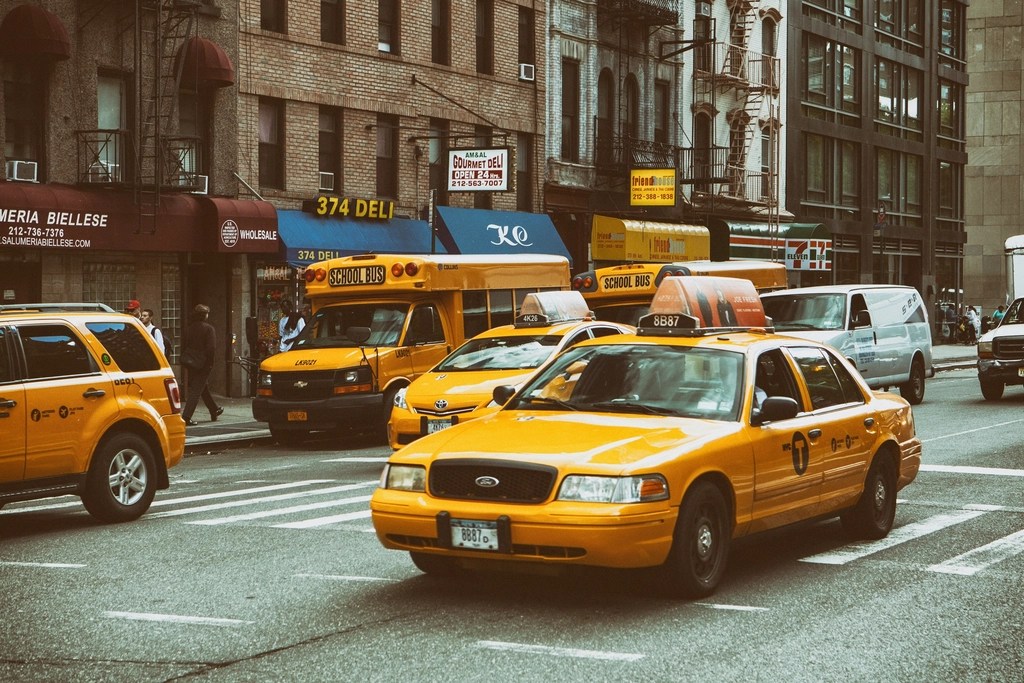
Oh, and an important tip about driving in the US: Don’t overtake school buses. Just don’t do it. States will impose pretty hefty fines on you if you’re caught, and if you’re a repeat offender you can get your licence suspended. (Plus, you run the risk of hitting schoolchildren, which is generally considered a Bad Thing.)
Undertaking
In the UK, undertaking is frowned upon (even if not technically illegal). In the U.S., on the other hand, it’s generally allowed on multi-lane roadways or to pass left-turning vehicles. State laws can vary as to situations that permit undertaking, however.
Toll Roads/Turnpikes
Quite a few highways in the U.S. are toll roads. Remember to carry money to pay for them. Although the U.S. is a lot better with accepting cards and mobile payments these days, there’s still a few places on the road where cash will still be king.
Other toll roads use cashless methods. In New York, for example, the MTA uses a tool called the “E-ZPass” to automatically bill vehicles when required. Rental cars often come equipped with an E-ZPass, and you shouldn’t ignore it — paying with cash (or not paying at all) is almost always more expensive.
Road Safety
Not to alarm you, but if it feels like driving is more dangerous in the U.S. than in the UK, that’s because it is.
The UK has some of the safest roads in the world. The U.S., on the other hand, has some of the most dangerous. Every year, vehicles in the U.S. cause 40,000 deaths and 2.7 million injuries. That makes crashes one of the top-five causes of death in the U.S.
There are various reasons for this. They include the fact that American drivers are more likely to look at their mobile phones while at the wheel, as well as a disturbingly relaxed attitude towards drink-driving among some drivers. Also important are the different designs of roads and cars — you’ll soon notice that both are bigger and, unfortunately, more dangerous.
In any case, focus on what you can control: being a good (defensive) driver yourself.
If You’re Stopped by the Police
In the UK, a lot of enforcement is done by cameras and the dreaded letter through the front door inviting you to an “awareness course”. In the U.S., local police departments carry out much of the enforcement themselves in person.
If, for any reason, you are flagged by the police, you may not have done anything too heinous — perhaps you failed to notice a damaged light or something — but in any case, pull over to the side of the road as soon as you can do so safely and remain in your car with both hands on the wheel. Do not exit your vehicle, and be polite and courteous with the officer.
Know Your Rights
For those of you who are about to hop in your car and take to the American roads, here’s a handy guide from the ACLU to read before you set off.
Drive safe, everyone.

Join the Conversation!
Excited to start a new life in the U.S. but unsure where to begin? Become a transatlanticist today for access to expert advice, exclusive discounts, and a community of friendly people who can help you cross the pond with confidence
 transatlanticists
You must be logged in to post a comment.