

The O-1 visa is a nonimmigrant visa for individuals with extraordinary abilities in certain fields. It’s divided into two categories:
(1) O-1A (extraordinary ability in business, science, arts, education and athletics)
(2) O-1B (extraordinary ability in the arts, or in the motion picture/TV industry).
The USCIS Policy Manual contains detailed information about these increasingly popular visa options. It also has a useful appendix outlining the kinds of evidence you can expect to submit for both the O-1A and O-1B.
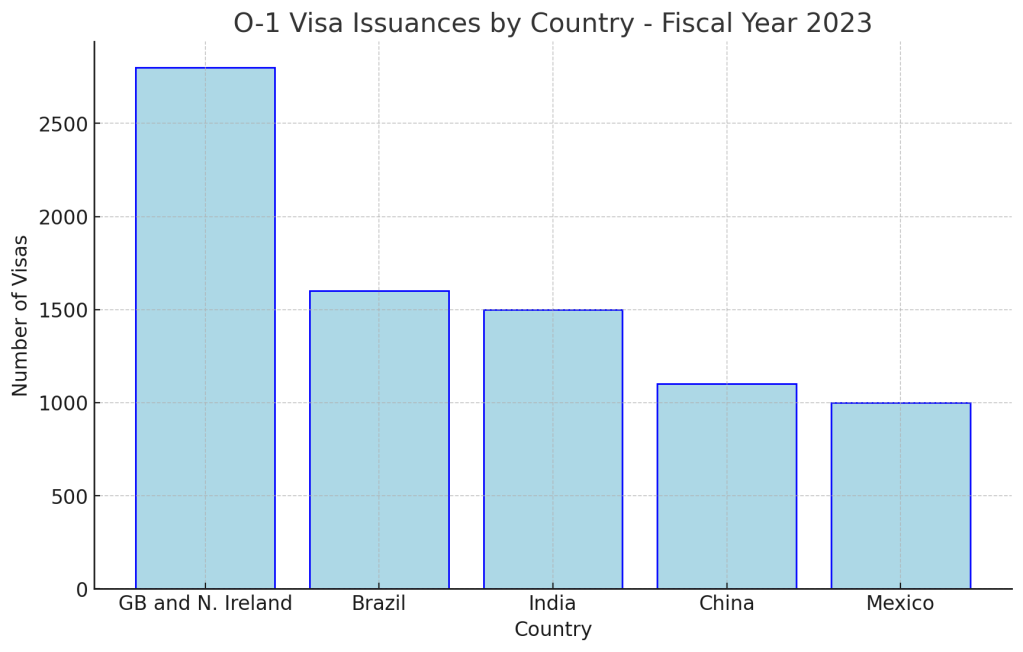
Sometimes, you’ll hear the O-1 visa described as the “Einstein Visa”, but don’t let that put you off. After all, no one sent more O-1 visa holders to the U.S. last year than us Brits:
How to Get an O-1 Visa
O-1A Visa: For Individuals with Extraordinary Ability in Sciences, Education, Business, or Athletics
The O-1A Visa is tailored for individuals who demonstrate extraordinary ability in the sciences, education, business, or athletics. To qualify, applicants must provide substantial evidence of their achievements and recognition in their field.
Eligibility Criteria:
- Extraordinary Ability: Applicants must showcase sustained national or international acclaim. This can be evidenced through awards, published material, membership in prestigious organizations, original contributions to the field, high salary, or significant participation as a judge of others’ work.
- Intent to Continue Work: Applicants must intend to continue working in their area of expertise while in the U.S.
Receipt of Major Awards or Prizes:
- Examples include Nobel Prizes, Pulitzer Prizes, Olympic Medals, or other internationally recognized awards for excellence in the field.
If you have one of these major awards, congratulations, you’re all set—but if (as is more likely) you don’t, you’ll need to show 3 of the following 8 criteria:
1. Awards
- This requires ‘the beneficiary’s receipt of nationally or internationally recognized prizes or awards for excellence in the field of endeavor’. It doesn’t have to be at the Olympic or Nobel level! USCIS mentions the following as examples:
- Awards from well-known national institutions and well-known professional associations.
- Certain doctoral dissertation awards and Ph.D. scholarships.
- Certain awards recognizing presentations at nationally or internationally recognized conferences.
2. Membership
- Membership in associations that require outstanding achievements for membership, such as national academies or professional organizations with selective membership criteria.
3. Published Material About the Applicant
- Articles, reviews, or features in major media outlets, professional journals, or significant trade publications that highlight the applicant’s work and achievements.
4. Judging the Work of your Peers:
- Serving as a judge of the work of others in the same or a related field, either individually or as part of a panel, which demonstrates recognition by peers.
5. Original Scientific, Scholarly, or Business-Related Contributions:
- Evidence of original contributions of major significance to the field, such as pioneering research, innovative business strategies, or significant advancements in a particular area.
6. Authorship of Scholarly Articles:
- Publication of scholarly articles in professional journals or other major media in the field, showcasing the applicant’s expertise and contributions.
7. Employment in a Leading or Critical Role for a Distinguished Organization:
- Holding a leading or critical position for organizations or establishments with a distinguished reputation, indicating the applicant’s importance and influence within the field.
8. High Salary or Remuneration:
- Demonstrating that the applicant commands a high salary or other significantly high remuneration for services compared to others in the field, reflecting their exceptional ability.
Application Process:
- Petition Filing: A U.S. employer, agent, or sponsor must file Form I-129, Petition for a Nonimmigrant Worker, on behalf of the applicant.
- Supporting Documentation: Comprehensive evidence must be provided, including letters of recommendation, media coverage, and documentation of awards or recognitions.
- Consultation: A written advisory opinion from a relevant peer group or labor organization is typically required to validate the applicant’s extraordinary ability.
Documentation Tips:
- Highlight major achievements and recognitions.
- Include detailed letters from experts attesting to your expertise and contributions.
- Provide evidence of your role in significant projects or organizations.
Processing Time:
- Standard processing can take several months, but premium processing is available for an additional fee, expediting the decision to within 15 calendar days.
O-1B Visa: For Individuals with Extraordinary Ability in the Arts or Extraordinary Achievement in the Motion Picture or Television Industry
The O-1B Visa caters to artists and individuals in the motion picture or television industries who have demonstrated extraordinary ability or achievement. It’s not just for Hollywood types, though! It’s possible to be creative with the O-1B visa, and include professions like marketing, culinary arts, and content creation, among many others.
Eligibility Criteria:
- Extraordinary Ability in the Arts: Applicants must show distinction in their field, evidenced by a high level of achievement such as leading roles, critical acclaim, or significant commercial success.
- Extraordinary Achievement in Motion Picture/Television: Applicants must demonstrate a record of extraordinary achievement evidenced by a significant body of work and recognition from organizations with expertise in the field.
O-1B Criteria
The standard for O-1B is arguably somewhat lower than the standard for the O-1A, focusing more on ‘distinction’ rather than sustained acclaim.
Applicants must demonstrate distinction by providing evidence of at least three of the following six criteria:
- Lead or starring roles for Distinguished Organizations:
- Participation in productions as a lead or starring role in organizations with a distinguished reputation, ‘as evidenced by critical reviews, advertisements, publicity releases, publications, contracts, or endorsements’.
- Leading or Critical Roles for Distinguished Productions
- Evidence of critical reviews or commercial success for the performances or productions in which the applicant has participated.
- Commercial or Critical Success:
- USCIS evidenced by indicator such as title, rating, standing in the field, box office receipts, motion pictures or television ratings, and other occupational achievements reported in trade journals, major newspapers, or other publications.
- High Salary or Remuneration:
- Documentation showing that the applicant commands a high salary or other significant remuneration in relation to others in the field.
- Significant Recognition from Experts:
- Receipt of significant recognition from organizations, critics, government agencies, or other recognized experts in the field. This often involves asking for experts in your field to write in glowing terms about you.
- Published Material About the Applicant:
- Articles, reviews, or features in major media outlets, professional journals, or significant trade publications that highlight the applicant’s work and achievements.
Application Process:
- Petition Filing: As with the O-1A, Form I-129 must be filed by a U.S. employer, agent, or sponsor.
- Supporting Documentation: This includes contracts, proof of past performances, critical reviews, and awards. For those in the motion picture or television industry, a detailed itinerary of events or projects in the U.S. is required.
- Consultation: An advisory opinion from a relevant labor organization or peer group is necessary to substantiate the applicant’s extraordinary ability or achievement.
Documentation Tips:
- Showcase a portfolio of work, including recordings, performances, or published works.
- Provide testimonials from industry professionals or critics.
- Include evidence of significant recognition, such as awards or nominations.
- Include articles from newspapers and trade publications about you and your work
Processing Time:
- Similar to the O-1A, standard processing times can vary, but premium processing is available to expedite the application process, guaranteeing a decision within 15 business days.
General Tips for O-1 Visas
- Comprehensive Documentation: The strength of your application generally lies in the quality and quantity of supporting evidence. Ensure all documentation clearly demonstrates your extraordinary ability or achievement.
- Professional Assistance: Consider hiring an immigration attorney who is familiar with the ins and outs of O-1 Visas to navigate the complex requirements and enhance the likelihood of approval.
O-1 Visa: Government Filing Fees & Other Costs
On April 1, 2024, USCIS implemented a new fee regime, with filing fees for most employment-based visas now dependent on the size of the employer (petitioner). For the O-1, that looks like this:
USCIS fees
(a) Employers with no more than 25 employees
- $530 Form I-129 fee
- $300 Asylum Program Fee
(b) Employers with more than 25 employees
- $1,055 Form I-129 fee
- $600 Asylum Program Fee
Visa issuance fee
- $205 visa issuance fee (at the U.S. Embassy stage)
Premium Processing
- $2,805 for a guaranteed decision within 15 business days
U.S. immigration lawyers
As for immigration lawyers, costs will vary wildly, but you can expect a (good) O-1 immigration lawyer to set you back at least £5,000, and often significantly more. The O-1 is a laborious, document-intensive petition, and lawyers charge accordingly.
O-1 Visa: FAQs
Q: How long are O-1 visas granted for?
A: Usually 3 years in the first instance. It is possible to renew your O-1 visa, generally in one-year increments.
Q: Can my spouse/children come with me?
Yes, the spouse or children (well, the unmarried ones aged under 21) of O-1 visa holders are generally eligible for an O-3 visa. This allows them to enter and live in the US with you. The downside is that the spouse of an O-1 cannot work on an O-3 visa.
Q: Does an O-1 visa lead to a green card?
Not automatically, but we like to think of the O-1 as a kind of ‘soft launch’ for an EB-1A green card, which has many of the same criteria, even though it represents a higher bar. Talk to an immigration lawyer about your eligibility.


Join the Conversation!
Excited to start a new life in the U.S. but unsure where to begin? Become a transatlanticist today for access to expert advice, exclusive discounts, and a community of friendly people who can help you cross the pond with confidence
 transatlanticists
You must be logged in to post a comment.